At Trackr, we’ve conducted over 700 CV reviews, and one issue comes up time and time again: students using poorly formatted or unsuitable resume templates.
In investment banking and financial services, attention to detail is everything. If you’re using a template with formatting issues or unnecessary sections, you risk having your resume thrown out before they even read it.
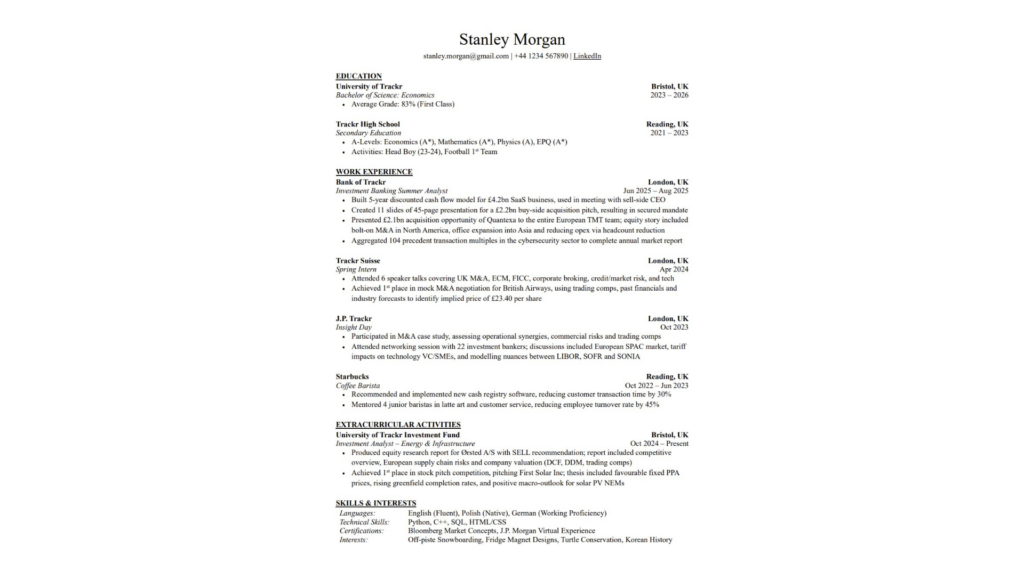
This CV template is optimal for all roles across finance, including investment banking, sales & trading, asset management, private equity, hedge funds, consulting, equity research, wealth management and audit.
This template has been ATS-checked, ensuring that your application isn’t rejected by automated filters.
Whether you’re applying for a spring week, summer internship, off-cycle internship, graduate scheme, or a 12-month industrial placement, this template is suitable for all.
The template is just the starting point. Read more on how to write a CV effectively in our CV guide.

What’s Included in the Template?
The CV is structured into four core sections:
1. Education
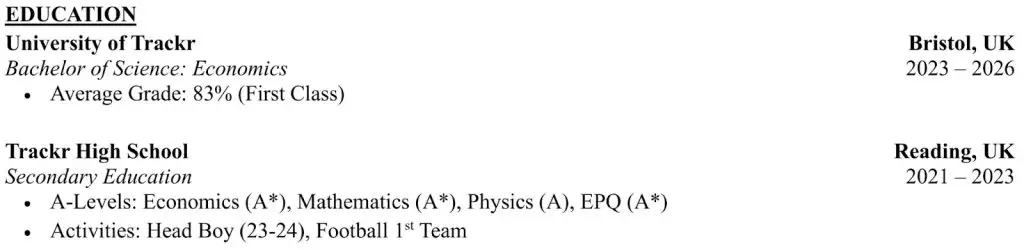
While you’re still a student, the Education section should appear at the top of your CV. Make sure to include your university and high school, along with your average university grade and A-Level (or equivalent) results.
You don’t need to include GCSE grades when applying for undergraduate opportunities.
Only list modules if they’re directly relevant to the role you’re applying for, or if you need to fill more space on your CV. You may also mention society involvements here, especially if it doesn’t warrant a full entry in the Extracurricular Activities section.
2. Work Experience

This section should highlight any relevant experience such as internship, spring weeks, and work experience programmes. You should also include non-relevant paid work (e.g. working at Starbucks).
List your experiences in reverse-chronological order and always prioritise relevant experience over non-relevant roles.
Avoid including university societies, volunteering or online courses here. Those should go in your Extracurricular Activities or Additional Information sections instead.
Each experience header uses text boxes to ensure consistent alignment and formatting. Refer to the second page of the template file to see how to create or delete experiences.
We have provided sample bullet points for internships, spring weeks, insight days and non-relevant experiences so you can see how these bullet points should look.
3. Extracurricular Activities

This section should include any society involvements, volunteering, and online courses you’ve completed. If you’re a first-year student, it’s common to have more entries in this section. However, as you gain more relevant experience, you should reduce the content in this section and prioritise space for internships.
4. Skills & Interests

This section is used to highlight other useful information that wasn’t included elsewhere, most notably your languages, technical skills and interests.
How to use the Trackr CV Template?
- Download the Trackr CV Template in .docx format here
- Replace the header text with your own name, phone number, email address and LinkedIn hyperlink
- Replace the filler content with your own experiences and bullet points. Follow the same bullet point format
- Delete the second page of the template
- Save as a .pdf file with the name “[First Name]_[Last Name]_CV.pdf”
Trackr CV Template Download
Ensure that you are viewing the template on desktop/laptop. You can download the Trackr CV template here:
If you’re looking for a comprehensive CV review from working professionals who received 10+ offers each, check out our Trackr CV Review service.