



Krish Lakhani
Boston Consulting Group (BCG)
Introduction
Consulting is an industry widely discussed, yet few fully understand what it entails. This article aims to demystify the industry, offering a comprehensive overview into daily life at top firms such as McKinsey and BCG.
What is consulting?
At its most granular level, consulting firms provide advice on solving difficult business problems. For example, Costa Coffee may need help growing its revenues, or Netflix may want support in acquiring a new streaming service provider.

Consulting work is both broad and diverse, with clients typically using the engagement to leave with a much clearer direction of where to direct their company. Often, many people still don’t fully understand why consultants are needed, especially when they are advising employees who have worked at their companies for several years. This is a common misconception; and in fact consultants add value in multiple ways.
First, consultants have extensive experience in solving business problems, as a result they can leverage their proven methodologies and industry knowledge to provide answers that internal employees cannot. Second, a McKinsey or BCG team brings the brightest, most competent minds to structure and tackle completely unfamiliar issues quickly. As such, they can rapidly collect and analyse data to provide recommendations. Last, internal employees often face considerable red tape in resolving issues. Subsequently, consultants can provide an external perspective and escalate issues far quicker whilst having the right mandate to do so. It is for these exact reasons that consulting can be an attractive place to start your career, whether through a consulting internship or consulting graduate role.
Why start a career in consulting?
Understanding the benefits of working in consulting can help explain whether it aligns with your career goals. First, you develop a strong skillset through the rapid pace and diversity of projects. This skill set is widely applicable to other roles, e.g. in-house strategy roles, government, startups, among others. Second, there are great opportunities to network. Having the ability to work in different industries and different clients exposes you to incredibly influential people that can support your career journey. This supports exit opportunities as well as growing your network. Third, you are surrounded with equally driven individuals. Consulting values different interests, working styles and degrees, but everyone is united by the common expectation of striving to do well and being highly motivated individuals.
The next section will unpack the different types of consulting you can get involved with, along with the consulting firms themselves.
Different types of consulting
There are various forms of consulting you can join as a consulting graduate that will be explained below.
Strategy Consulting |
|
Management Consulting |
|
Economic Consulting |
|
Different consulting firms
MBB (McKinsey) (BCG) (Bain) |
|
Tier 2 (Oliver Wyman) (Strategy&) (L.E.K) (OC&C) (Simon Kucher) (Roland Berger) (EY Parthenon) |
|
Big 4 (Deloitte) (EY) (PwC) (KPMG) |
|
Boutiques |
|
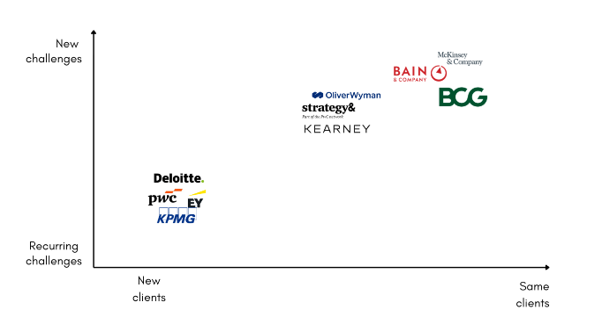
A common misconception about consulting is when you hear of the ‘Big Four’ you automatically think of these companies as the most prestigious in consulting. However, whilst they are highly reputable firms, the best talent and most sophisticated problems to solve lie with MBB and Tier 2 companies. The diagram below illustrates this, with MBB often described as solving the world’s most difficult problems.
Consulting salaries are also heavily spoken about, and they can range considerably depending on the type of firm you join. MBB & Tier 2 traditionally pay the highest, c.45-60k whereas Big 4 and Boutiques pay closer to c.32k-45k. It is worth noting that consultancies are becoming more stringent with UK Skilled Worker Visa requirements, with most opportunities for sponsorship existing more focused among MBB and Tier 2 firms.
What does a typical week look like?
Project teams usually consist of 3-5 people, sometimes more or less depending on the scale of the project and deliverables. There are a few recurring types of work conducted by consultants:
- Powerpoint: This is one of the most widely used applications because consultants are very often building out slides to present to the client. This may be used to tell a story about the project you are working on, whether that’s presenting research, showing the output of your interviews or summarising your key actions to the client.
- Excel: This is useful in building models and processing/analysing large amounts of data to identify insights, test hypotheses and substantiate conclusions. This is typically used for market sizing, and is consistently iterated based on feedback from client/partners/managers until it is finalised.
- Other research methods: Consultants could engage in wider market research and trends via different techniques e.g. expert interviews, focus groups, analysing client internal processes. This helps provide qualitative insights and context into changes currently happening within clients’ industries and market positioning.
How to Break Into Consulting?
Joining as a consulting intern or consulting graduate can be a highly fulfilling role but is also extremely competitive. As a university student there are many different paths. Spring weeks / mentorship schemes are not as common in comparison with finance, but they do exist. Firms that offer spring weeks include McKinsey, BCG, the Big Four among others, but few convert to full-time offers. As such, consulting summer internships become a strong way to break in, but they are traditionally more competitive than finance applications due to the limited spots. For example, Oliver Wyman’s summer internship has 14 places out of 5000+ applicants highlighting the limited spots. Therefore, graduate roles are often the best way to break in, often seen as less competitive than consulting summer internships with more companies offering them.
Conclusion
Consulting is definitely a viable career path for many, and often seen as one of the best places to start your career given its exposure and breadth of work. However, it is incredibly competitive so it is important to ensure you prepare yourself accordingly. These posts aim to bridge that gap, and allow you to excel in the consulting application process.
About Me
To introduce myself, I am an incoming MBB consultant and I have previously completed an internship at a Tier 2 consultancy. I have received offers from 7 prestigious consulting firms and interviews with several others.These blogs share my experience to help you navigate the consulting application process with more confidence.
![]()